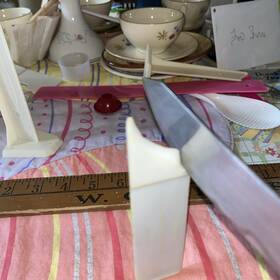
( Brand: Knife ), ( Manufacturer Part Number: 415-2 ), ( Material: Plastic ), ( Country Of Origin: United States )
Review KNIFE Tupper Sharpener By Corporation #415-2
The **1958 Tupperware Knife Sharpener (Model 415-2)** is a meticulously crafted, mid-century design piece that seamlessly blends functionality with timeless elegance, embodying the ingenuity of its era. This iconic sharpener, originally introduced by the Tupperware Corporation in the late 1950s, was not merely a tool but a statement of domestic innovation, reflecting the company s broader mission to simplify household tasks through clever, durable design. Crafted from high-quality, heat-resistant **polyethylene plastic**, the sharpener features a sleek, rounded body with a smooth, matte finish that has stood the test of time, resisting wear and maintaining its polished appearance even after decades of use. Its compact yet sturdy construction measuring approximately **4.5 inches in length and 2.5 inches in diameter** allows it to fit effortlessly into kitchen drawers, countertops, or even small pantry spaces without sacrificing performance.
At the heart of the sharpener s design lies its **dual-stage sharpening mechanism**, a revolutionary concept for its time that ensures knives retain their razor-sharp edge with minimal effort. The outer ring, designed for **coarse grit sharpening**, is ideal for restoring dull blades or correcting uneven edges, while the inner, finer ring provides a **polishing finish** that leaves blades honed to a near-mirror-like sharpness. The sharpener s **rotating wheel** operated by a simple twist of the wrist grinds against the blade at a precise angle, maintaining the original bevel while removing metal evenly, a method that remains as effective today as it was in 1958. The absence of complex moving parts or fragile components means it requires no lubrication, oil, or maintenance beyond occasional cleaning with a damp cloth, making it a low-friction, hassle-free solution for home cooks and culinary enthusiasts alike.
Beyond its practical utility, the **1958 Tupperware Knife Sharpener** is a collector s treasure, embodying the **mid-century modern aesthetic** that defined an era of optimism and innovation. Its **subtle pastel or neutral color options** originally available in shades like **cream, light green, or pale blue** add a touch of vintage charm to any kitchen, serving as both a functional tool and a decorative accent. The sharpener s **ergonomic grip**, with its slightly textured surface, ensures a comfortable hold, while its **durable, non-slip base** prevents it from shifting during use. Over the years, this design has become a symbol of **Tupperware s legacy of practicality**, proving that even the most utilitarian objects can possess enduring beauty when crafted with intention.
For those who appreciate **retro design, kitchen nostalgia, or the marriage of form and function**, the **Model 415-2** is more than just a sharpener it s a piece of living history. Whether used daily to maintain a chef s knife or displayed as a conversation piece, it bridges the gap between the past and present, offering a reliable, no-frills solution to a task that has been performed for centuries. Its **timeless simplicity** ensures that it remains as relevant today as it was in 1958, a testament to the enduring power of thoughtful design.
### **Pros and Cons of Buying a 1958 Tupper Knife #415-2 Sharpening Tool**
#### **Pros**
1. **Durability and Longevity** The Tupper sharpening tool is made from high-quality materials, including a sturdy metal frame and durable abrasive surfaces. Its vintage design suggests it was built to last, making it a reliable tool for decades of use.
2. **Effective Sharpening** The tool is specifically designed to sharpen knives efficiently, including serrated edges. The abrasive surfaces (likely aluminum oxide or silicon carbide) provide consistent results, restoring a sharp edge without excessive effort.
3. **Versatility** The #415-2 model appears to be a multi-purpose sharpener, capable of handling various knife types, from kitchen blades to utility tools. The adjustable or interchangeable components may allow for fine-tuning sharpening angles.
4. **Manual Control** Unlike electric sharpeners, this manual tool gives users precise control over the sharpening process. This can be particularly useful for maintaining a consistent bevel on custom or hand-forged knives.
5. **Historical and Collectible Value** As a 1958 model, the Tupper sharpener may hold nostalgic or collectible appeal for enthusiasts of vintage tools. Some users appreciate the craftsmanship of mid-century industrial design.
6. **Low Maintenance** Unlike some modern sharpening systems, this tool likely requires minimal upkeep. Regular cleaning and occasional reapplication of abrasive compound (if needed) may be all that s required to keep it in working order.
7. **Cost-Effective for Long-Term Use** While the initial purchase price may be higher than disposable sharpening stones, the tool s durability and longevity can make it a cost-effective investment over time.
---
#### **Cons**
1. **Age and Wear** Being from 1958, the tool may show signs of wear, such as rust, chipped edges, or degraded abrasive surfaces. If not properly maintained, it could require restoration before use.
2. **Potential for Inconsistent Results** Older sharpening tools may not have the same precision as modern alternatives. The abrasive surfaces might wear unevenly over time, leading to less predictable outcomes.
3. **Limited Availability of Parts or Replacements** Finding replacement parts or abrasive surfaces for a vintage Tupper sharpener could be difficult. Modern manufacturers may no longer produce compatible components.
4. **Learning Curve** Mastering the technique for using this tool effectively may require practice, especially if the user is unfamiliar with manual sharpening methods. Improper use could dull the knife further or create uneven edges.
5. **Size and Portability** The tool may be bulkier or less portable than modern electric sharpeners or compact whetstones. This could be a drawback for users who prioritize convenience and mobility.
6. **Maintenance Requirements** Unlike some modern sharpeners that are plug-and-play, this tool may require periodic cleaning, oiling, or re-abrasive treatment to maintain optimal performance.
7. **Potential for Over-Sharpening** Without proper technique, users might accidentally over-sharpen the knife, reducing its thickness or creating a weak edge that chips easily.
---
### **Conclusion**
The 1958 Tupper Knife #415-2 sharpening tool is a robust, manually operated device with a reputation for effectiveness and durability. It offers precise control over the sharpening process and may appeal to those who value traditional craftsmanship or collectible tools. However, its age introduces potential challenges, such as wear, limited availability of parts, and a steeper learning curve compared to modern alternatives.
For **knife enthusiasts, collectors, or those who prioritize manual sharpening techniques**, this tool could be a worthwhile investment, provided it is restored or maintained properly. On the other hand, **casual users or those seeking convenience** might find modern electric sharpeners or whetstones more practical.
### **Recommendation**
If you are interested in purchasing this tool, consider the following steps:1. **Inspect the Condition** Check for rust, cracks, or worn abrasive surfaces. If the tool is heavily damaged, restoration may be necessary before use.
2. **Test the Abrasive Surfaces** Sharpen a disposable knife to gauge the effectiveness of the tool. If the results are unsatisfactory, the abrasive surfaces may need replacement.
3. **Compare with Modern Alternatives** If your primary goal is efficiency and ease of use, weigh the pros and cons against modern sharpeners like diamond whetstones or electric sharpeners.
4. **Consider Your Skill Level** If you are new to manual sharpening, practice on inexpensive knives first to get a feel for the technique.
5. **Purchase from a Reputable Source** Ensure the tool is authentic and in good condition, ideally from a seller with a return policy or warranty.
Ultimately, the Tupper #415-2 is a **strong choice for dedicated sharpeners who appreciate vintage tools and are willing to invest time in mastering its use**. For most everyday users, however, a modern whetstone or electric sharpener may offer a better balance of convenience and performance.
Details:
Written on it and not Tupperware. Tupperware at one point in history had Tupper.
part #: 4152 prices
- $8.00-$20.00
specifications sharpeneroz:
- brand: Knife
- mpn: 415-2
- material: Plastic
- country of origin: United States
shipping sharpeneroz:
- type: Calculated
- cost: $6.37
- class: Standard
- carrier: USPS
- transit: 3-7 Days
- service: USPS Ground Advantage
seller sharpeneroz:
- # reviews: 1129
- city: Menasha, Wisconsin
- rating: 99.9%
payments sharpeneroz:
- other
- credit card: Discover
- wallet: Paypal
offer sharpeneroz:
- availability: In Stock
- started: June 10, 2026
- sold: 0
- quantity: 1
- options: Ship-to-home
general sharpeneroz:
- Kitchen, Dining Bar > Kitchen Tools Gadgets > Sharpeners
- condition: Used
returns sharpeneroz:
- policy: No Returns
Knife 415-2 Is Similar To:
- 00092187079467 New Manual Knife Sharpener System Oil (33.6% similar) Great for helping your blades stay looking and performing like new, this Knife sharpener system is ideal to keep close at hand in kitchen. Keep your blades sharp and ready for use thanks to this Dexter-Russell 12 manual Teri-stone Knife sharpener system. 3 stones the 100 grit stolon stone helps ...(July 17th, 2018)
- 001-003 Accusharp 001 Knife Sharpener 812147011173 (32.4% similar) The large ergonomic handle fits either hand safely and securely. Sportsmen, cooks, craftsmen, gardeners, and many more, all need the easy-to-use, affordable airship line of Knife tool sharpeners. Replacement sharpening blades are available. Sharpening blades are diamond honed tungsten carbide for ...(May 23rd, 2017)
- 0015896000010 White Accusharp Knife Tool Sharpener With Full Length (31.3% similar) Sharpening blades are diamond honed tungsten carbide for years of reliable use. Airship Knife 001 tool sharpener 001C white with full length finger guard thumbnails to finally, a anyone can use. The full length finger guard protects your fingers. In about 10 seconds, sharpen knives, even ...(September 14th, 2018)
- 0016l6 Unbranded In Knife And Scissor Sharpener New Hand Ships From (35.9% similar) Handle makes for easy grip while sharpening your knives. 51INCH x package included: 1 x Knife sharpener. 76INCH x simple and easy to use this instrument sharpen knives scissors. 6CM SIZE:14CM x 7CM sharpen more than 10,000 blades...(May 12th, 2018)
- 001e Fortune Products Accu Knife Sharpener (29.1% similar) Free shipping items are only shipped of charge to addresses in the contiguous USA. Please feel free to with any shipping questions or concerns...(February 17th, 2017)
- 00cgvj4yo Knife Sharpener Image Professional Kitchen System Kit Version Ii With (31.4% similar) Quick and easy way to sharpen Knife blade. Color ruler to show the accurate Knife angle. Hope you like my suggestions. Color ruler to show the accurate Knife angle come with 4 high quality stones, 600 and is not included. Simple reassembling needed more stable sucker disc base. Sharpening stone can ...(March 2nd, 2019)
- 01-b0018rsemu Professional Electric Knife Sharpener Diamond Abrasives And Edges (28.6% similar) Time required to sharpen: approximately 1 minute for first sharpening. Resharpening is approximately 10 seconds ideal for converting traditional 20 degree factory edges of household knives into high performance trios xv advanced, patented flexible spring guides accurate control the sharpening angle...(April 30th, 2018)
- 010002501 Amethya Knife Sharpeners Sharpener 854619007567 (35.6% similar) As the topic to avoid inadvertently opening a case. Works for right or LEFT-HANDED3-STEP sharpening process: 1ST slot rod repairs and straightens damaged blades. Cooking has to be fun, safe, and above all, made with well sharpened knives. Please refer to the return instructions and follow them ...(November 2nd, 2017)
- 0101508 Chefs Choice Trizor Xv Edgeselect Electric Knife Sharpener Brushed Metal (27% similar) ...(April 3rd, 2018)
- 0115200 Chef Schoice Angleselect Diamond Hone Electric Knife Sharpener 087877015207 (26.4% similar) First via message in case of any problems. This advanced electric sharpener can restore and recreate both a 20 degree edge for European American knives 15 Asian. Chef choice angle select 1520 diamond hone electric Knife sharpener for 15 and 20-DEGREE knives 100-PERCENT abrasives stropping precision ...(March 5th, 2018)
- 01212601 Boj Vintage Knife Sharpener Wheel Sharpening System Made In America (32.1% similar) Made in USA. A j very old vintage 8 wheel sharpening system. Red wood en handle...(July 18th, 2018)