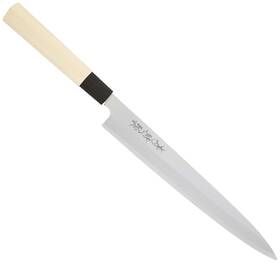
( Brand: Kotobuki ), ( Manufacturer Part Number: 440-122 ), ( Part Type: Knife ), ( UPC: 846682025937 ), ( Gtin: 00846682025937 )
Review KOTOBUKI High carbon Sk-5 Japanese Yanagi Sashimi Knife 240mm
The **Kotobuki 440-122 High-Carbon SK-5 Yanagi Sashimi Knife (240mm)** is a masterfully crafted Japanese chef s knife that embodies both precision and artistry, designed for those who demand excellence in the kitchen. Forged from **SK-5 steel**, a high-carbon alloy renowned for its exceptional hardness and edge retention, this blade achieves a razor-sharp finish that remains consistently sharp even after prolonged use, making it ideal for delicate tasks like slicing sashimi, filleting fish, or preparing fine vegetables. The **yanagi (willow leaf) profile** of the blade thin, slightly curved, and tapering gracefully to a fine point enables effortless control, allowing the chef to glide through ingredients with minimal effort while maintaining precision. The **240mm (9.45-inch) length** strikes a perfect balance between maneuverability and cutting power, making it versatile for everything from intricate sashimi cuts to broader prep work.
The handle of this knife is a study in ergonomic elegance, crafted from **high-quality Japanese hardwood** and meticulously fitted with a **stainless steel bolster** for added durability and balance. The **full tang construction** ensures stability and strength, while the **D-shaped handle** provides a secure, non-slip grip, even when wet, allowing for extended use without fatigue. The knife s **polished finish** not only enhances its aesthetic appeal but also makes it easy to clean and maintain, a crucial consideration for professional kitchens where hygiene is paramount.
Beyond its technical superiority, the **Kotobuki 440-122** carries the legacy of Japanese craftsmanship, where every detail from the blade s heat treatment to the handle s sanding is executed with meticulous care. Whether used by a home cook seeking unmatched precision or a professional chef refining their technique, this knife transcends its function as a tool to become an extension of the user s skill, elevating every cut to a near-perfect artistry. Its blend of **durability, sharpness, and ergonomic design** makes it a timeless investment for anyone serious about culinary excellence.
The **Kotobuki 440-122 High-Carbon SK-5 Yanagi Sashimi Knife (240mm)** is a high-end Japanese knife designed for precision cutting, particularly for fish and delicate ingredients. Below is a detailed breakdown of its pros and cons, followed by a conclusion and recommendation.
---
### **Pros**
1. **Premium Steel Composition**
- Made from **SK-5**, a high-carbon Japanese steel (typically 1.5 1.6% carbon) with a hardness of around **60 62 HRC**. This combination offers exceptional edge retention and sharpness, making it ideal for sashimi work where clean, precise cuts are essential.
- The steel is often treated with **thermal hardening** to enhance durability while maintaining a fine edge.
2. **Yanagi (Ginsu) Grind**
- Features a **Yanagi grind**, a sharp, asymmetrical edge designed for slicing through fish and other delicate foods with minimal resistance. This grind reduces drag and allows for effortless cuts, which is critical for sashimi preparation.
- The blade tapers to a fine point, enabling intricate work like filleting or creating thin, even slices.
3. **Full Tang Construction**
- The blade extends fully into the handle, providing superior balance and strength. This design reduces flex during use and ensures the knife remains stable in the hand, which is important for precision tasks.
4. **Hand-Forged and Hand-Finished**
- Many high-end Kotobuki knives are **hand-forged** by skilled artisans, which contributes to the blade s uniformity and quality. The finish is often polished to a high sheen, indicating meticulous craftsmanship.
- The **clay tempering process** (often used in Japanese knives) helps refine the grain structure, improving both sharpness and toughness.
5. **Ergonomic Handle**
- The handle is typically made from **Japanese hardwoods** (e.g., magnolia, cherry, or walnut) and wrapped in **rayon or leather**, providing a comfortable grip with good friction. The balance point is often well-placed for reduced hand fatigue during extended use.
- Some models may include a **D-shaped or octagonal handle** for better control, though this can vary by manufacturer.
6. **Longevity and Resale Value**
- High-carbon Japanese knives like this one are known for their **longevity** if properly maintained. With regular honing and occasional sharpening, the blade can remain sharp for years.
- Well-maintained Kotobuki knives hold their value, making them a worthwhile investment for serious home cooks or professionals.
7. **Versatility Beyond Sashimi**
- While designed for sashimi, the Yanagi grind and sharpness make it useful for other tasks like **filleting, slicing vegetables, or even light boning**. Its precision can also be applied to other delicate cuts in the kitchen.
8. **Aesthetic Appeal**
- The knife often features a **sleek, traditional Japanese design** with a polished blade and handcrafted details, making it as much a decorative piece as a functional tool. This can be appealing for collectors or those who appreciate fine craftsmanship.
---
### **Cons**
1. **High Cost**
- This knife is positioned in the **premium to luxury range**, often retailing for **$200 $400 or more**, depending on the retailer and any additional features (e.g., custom handles or engravings). For casual cooks, this may be an unnecessary expense.
- The price reflects the materials, craftsmanship, and brand reputation, but it can be a significant investment for a single knife.
2. **Maintenance Requirements**
- High-carbon steel is prone to **rust and staining** if not properly cared for. The knife requires:- **Regular honing** (e.g., with a whetstone or diamond rod) to maintain the edge.
- **Occasional sharpening** (every few months to a year, depending on use) to restore the blade s sharpness.
- **Proper drying** after washing to prevent moisture buildup.
- Failure to maintain the knife can lead to dullness or damage over time.
3. **Not Ideal for Heavy-Duty Tasks**
- While excellent for sashimi and delicate cutting, the **thin blade profile** and high-carbon steel make it **less suitable for chopping bones, pounding, or heavy-duty tasks**. For these, a thicker, more durable knife (e.g., a gyuto or santoku) would be more appropriate.
- The Yanagi grind is optimized for slicing, not dicing or mincing, which may limit its versatility in some kitchens.
4. **Learning Curve**
- The knife s precision requires **proper technique** to avoid damaging the blade or the food. For example:- Pushing rather than pulling can dull the edge quickly.
- Incorrect grip or angle can lead to uneven cuts or blade wear.
- New users may need time to adjust to the knife s behavior compared to Western-style knives.
5. **Weight and Balance**
- Some users find the knife **lighter than expected** due to the thin blade, which can feel less substantial in the hand. While this isn t inherently bad, it may not suit those who prefer a heavier, more "stable" knife for cutting.
- The balance point is often toward the tip, which can be disorienting for those accustomed to Western knives with a more centered balance.
6. **Potential for Overkill**
- If you primarily cook Western-style dishes or don t frequently prepare sashimi, the **niche specialization** of this knife may not justify its cost. A high-quality **Japanese chef s knife (gyuto)** or **slicing knife** might offer better versatility for a similar price.
7. **Brand and Retailer Dependence**
- The quality can vary slightly depending on the **specific Kotobuki model** and the **retailer**. Some sellers may offer lower-quality replicas or poorly maintained knives under the same name. Buying from a reputable dealer (e.g., with a return policy or warranty) is advisable.
8. **Storage and Handling**
- The thin, sharp edge requires **careful storage** to avoid nicks or damage. A **knife block, magnetic strip, or sheath** is recommended to protect the blade when not in use.
- The knife s sharpness means it must be handled with caution to prevent cuts, especially in a home kitchen with children or pets.
---
### **Conclusion**
The **Kotobuki 440-122 SK-5 Yanagi Sashimi Knife** is a **superior tool for sashimi preparation and precision cutting**, offering unmatched sharpness, edge retention, and craftsmanship. Its Yanagi grind and high-carbon steel make it the best choice for those who prioritize **clean, delicate cuts** in their cooking. The knife s full tang, ergonomic handle, and aesthetic appeal further enhance its appeal to serious home cooks and professionals.
However, its **high cost, maintenance demands, and specialized nature** mean it may not be the best fit for everyone. It is best suited for:- **Sashimi enthusiasts** who require the finest possible cuts.
- **Home cooks or chefs** who value precision and are willing to invest in a high-quality tool.
- **Those who appreciate Japanese craftsmanship** and are prepared to maintain the knife properly.
For **casual cooks, heavy-duty users, or those on a budget**, a more versatile knife (e.g., a gyuto or santoku) might be a better choice. Additionally, if you don t frequently prepare sashimi, the knife s niche focus could make it underutilized.
---
### **Recommendation**
**Buy the Kotobuki 440-122 SK-5 Yanagi Sashimi Knife if:**- You are a **sashimi lover** or a cook who frequently works with delicate ingredients (e.g., raw fish, thin vegetable slices).
- You are willing to **invest in a premium knife** and commit to its maintenance (honing, sharpening, and proper care).
- You appreciate **Japanese craftsmanship** and the aesthetic of a hand-forged, high-carbon steel blade.
- You already own a **versatile chef s knife** and want a specialized tool for precision tasks.
**Avoid it if:**- You are a **casual cook** who doesn t frequently use sashimi knives.
- You prefer **versatility** over specialization and would rather have a knife that handles multiple tasks.
- You are **unwilling to maintain** a high-carbon steel blade properly (risking rust or dullness).
- Your budget is limited, and you d rather allocate funds to a more multipurpose knife.
**Alternative Considerations:**- If you like the Yanagi grind but want a more affordable option, consider **Shun or Global** sashimi knives, which offer similar performance at a lower price.
- For a **versatile Japanese knife**, a **high-quality gyuto (chef s knife)** or **santoku** would serve more general cooking needs.
- If you re unsure, try a **mid-range sashimi knife** (e.g., from **Mac** or **Kai**) to test your preference before investing in a premium model.
Ultimately, this knife is a **fantastic investment for the right user** one who values excellence in cutting and is prepared to care for it accordingly. For others, it may be an unnecessary splur
Details:
Superior balance between durability and sharp cutting edge. 9-1/2 Inch blade length . However, this will not affect the shipping times. The long, narrow shape of the yanagi blade allows user to slice fish in one smooth motion, eliminating any damage or tears flesh.
Made in Japan. The high-carbon SK-5 steel used in this knife ensures the perfect balance between durability and its ability to hold a very sharp edge.: A Japanese yanagi knife is the tool of choice when slicing fish for sashimi. Made of high-carbon SK-5 steel.
Brand New Kotobuki High-Carbon SK-5 Japanese Yanagi Sashimi Knife, 240mm, Manufacturer model: 440-122 The yanagi shape is a specialty knife for slicing sashimi.
part #: 440122 price
- $128.80
specifications sharpeneroz:
- brand: Kotobuki
- mpn: 440-122
- part type: Knife
- upc: 846682025937
- gtin: 00846682025937
payments sharpeneroz:
- other
- wallet: Apple-pay
- credit card: Mastercard
general sharpeneroz:
- Kitchen, Dining Bar > Kitchen Tools Gadgets > Sharpeners
- condition: New
returns sharpeneroz:
- time: 30 Days
- method: Money back
- policy: Returns Accepted
- paid by: Seller
seller sharpeneroz:
- city: Within USA
- rating: 100.0%
- # reviews: 53207
shipping sharpeneroz:
- type: Fixed
- cost: $0.00
- transit: 4-8 Days
- service: Standard
- class: Standard
offer sharpeneroz:
- started: February 27, 2026
- availability: In Stock
- options: Ship-to-home
- sold: 0
Kotobuki 440-122 Is Similar To:
- 440-106 Kotobuki Japanese Nakiri Vegetable 843495009567 (41.9% similar) From multiple suppliers. I will do everything in my power to make sure that your problem is resolved. Products are new and shipped from the us. Made to time-honored standards and exacting detail, this nacre knife has a thin, rectangular blade, perfect for cutting vegetables. JBB00TQPWDPU. 5 carbon ...(December 27th, 2017)
- 440955 Kotobuki Knife Sharpeners Suehiro 812594024061 (29.5% similar) We reply every message within 48 hours. Please by message only. A sharp, well honed edge is essential for clean cut. Japanese whetstones in particular are said to produce a finer edge than north American stones due the unique bonding process of stone during manufacturing. There are a number of ways ...(August 2nd, 2017)
- Cominhkg061064 Kotobuki Knife Sharpeners Suehiro 812594024054 (27.7% similar) We reply every message within 48 hours. A non-slip rubber base is included with this stone. A sharp, well honed edge is essential for clean cut. Kotobuki Superior japanese sharpening stone, dual-sided 1000 and 3000 grit, large, natural double sided water stone from one of the finest manufacturers ...(August 2nd, 2017)
- Kotobuki 837033004848 King 250 1000 k-80 Combo Knife Sharpening Stone Set Wet (34.2% similar) Coarse 250 grit for removing knocks and fine 1000 finishing. There are a number of ways to sharpen knife, but water stones the preferred method, because user has absolute control during sharpening process. Delivery information: our shipping is prompt and secure. Unique bonding process during ...(October 29th, 2024)
- Kotobuki 440-125 High-carbon Sk-5 Japanese Deba Fish Filleting Knife 165mm (79.7% similar) Superior balance between durability and sharp cutting edge.: a japanese debar knife is the tool of choice when filleting a fish. 6-1/2 inch blade length . The thick spine and one-sided beveled edge make it easy to process a whole fish, from removing the head cutting through bones, slicing fillet's...(February 27th, 2026)