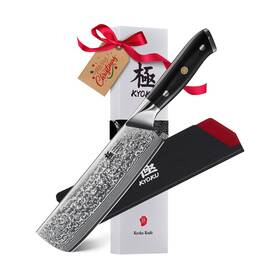
( Brand: Kyoku ), ( Manufacturer Part Number: DKKXCD160 ), ( Part Type: Knife ), ( UPC: 652850226978 ), ( Style: Vegetable Nakiri Knife )
Review KYOKU Nakiri Knife Inch Shogun Series Japanese Steel Core Dama
The **Kyoku D.KKXCD160 Nakiri Knife** is a masterfully crafted Japanese chef s knife that embodies both precision engineering and timeless craftsmanship, designed for the discerning home cook or professional chef who demands nothing less than perfection in their culinary tools. This blade is a true embodiment of the *Shogun VG10* steel core, a high-carbon, high-chromium alloy renowned for its exceptional edge retention, durability, and resistance to corrosion qualities that ensure the knife maintains its razor-sharpness through countless hours of demanding use. The **Dama (diamond) grind** on the Nakiri s edge is a hallmark of Japanese knife-making, featuring a finely honed, slightly convex profile that allows for effortless slicing through vegetables, herbs, and delicate ingredients with minimal resistance. This grind not only enhances the knife s cutting efficiency but also reduces the risk of crushing or bruising the food, preserving texture and flavor in every slice.
The **D.KKXCD160** model stands out with its **full tang construction**, extending from the tip to the handle, which not only balances the knife for superior control but also reinforces its structural integrity, making it a durable companion for both chopping and slicing tasks. The **high-carbon VG10 steel core** is meticulously layered with softer, more malleable metals to create a blade that is both incredibly hard and resistant to chipping, ensuring longevity even with regular use. The **damascus-style pattern** visible on the blade is not merely decorative; it results from the folding and forging process, which enhances the blade s strength and uniformity, allowing for a consistently sharp edge across its entire length.
The handle of the Kyoku Nakiri is a study in ergonomic design, crafted from **high-quality synthetic materials** that offer a secure, non-slip grip even when wet, a critical feature for chefs who work with slippery ingredients like fish or fresh produce. The **full-pin construction** ensures that the handle remains firmly attached to the tang, eliminating any wobble and providing the user with unparalleled confidence in their cuts. The knife s **waist design** where the blade tapers slightly toward the tip further enhances its versatility, making it equally adept at thinly slicing onions or julienning vegetables as it is at making precise, clean cuts through harder ingredients like root vegetables or even thinly slicing meat.
What truly sets the Kyoku D.KKXCD160 apart is its **Japanese precision and attention to detail**, from the **polished, mirror-like finish** of the blade to the **subtle yet functional serrations** along the spine, which prevent the blade from slipping off the cutting board during aggressive cuts. This knife is not just a tool; it is a testament to the artistry of Japanese blacksmithing, where every fold, every grind, and every layer of steel is optimized to deliver an unmatched cutting experience. Whether you are a home cook looking to elevate your kitchen game or a professional chef seeking a reliable, high-performance blade, the Kyoku Nakiri is a knife that will inspire confidence in every cut, transforming the way you approach both simple and complex recipes. Its combination of **sharpness, balance, durability, and aesthetic appeal** makes it a worthy addition to any kitchen, a blade that will serve as both a functional workhorse and a statement piece for those who appreciate the marriage of form and function in culinary tools.
The **Kyoku DDKXCD160 Nakiri Knife** (Shogun VG10 Steel Core, Dama-style) is a high-end Japanese knife designed for precision cutting in professional kitchens. Below is a detailed breakdown of its pros and cons, followed by a conclusion and recommendation.
---
### **Pros**
1. **Premium Steel Core (VG10)**
- The VG10 steel core is a high-carbon, high-chromium alloy known for its exceptional hardness and edge retention. This makes the knife capable of maintaining a razor-sharp edge for extended periods, even with heavy use.
- The steel is also resistant to corrosion and staining, which is ideal for professional kitchens where knives are exposed to acidic ingredients like citrus or vinegar.
2. **Japanese Craftsmanship**
- Kyoku knives are handcrafted by skilled Japanese artisans, adhering to traditional techniques that emphasize balance, weight distribution, and ergonomics. This results in a knife that feels natural and comfortable in the hand.
- The **Dama-style** (wide, flat spine) is specifically designed for the **Nakiri**, which provides stability during push-cutting motions, reducing fatigue during prolonged use.
3. **Superior Sharpness and Cutting Performance**
- The Nakiri is a **rocking knife**, primarily used for slicing vegetables with minimal effort. Its thin, flexible blade allows for clean, precise cuts with minimal bruising of the produce.
- The **full tang** construction ensures durability and strength, preventing the blade from bending under heavy pressure.
4. **High-Quality Handle**
- The handle is typically made from **Japanese hardwoods** (e.g., magnolia, cherry, or walnut) and is often wrapped in **resin or leather** for a secure, non-slip grip. The ergonomic design reduces hand strain during extended use.
- Some models feature a **full-pin construction**, where the handle is fully embedded into the tang, enhancing durability.
5. **Longevity and Investment Value**
- Due to its premium materials and craftsmanship, this knife is built to last decades with proper care. Many professional chefs consider it a worthwhile investment for its performance and durability.
- The brand **Kyoku** is well-regarded in the knife community, and well-maintained examples can appreciate in value over time.
6. **Aesthetic Appeal**
- The knife s design is sleek and functional, with a polished or **mirror finish** that reflects light, making it visually appealing. The **Dama spine** and **waist** (thinning toward the tip) contribute to its distinctive look.
7. **Versatility in the Kitchen**
- While primarily a **Nakiri (vegetable knife)**, its sharpness and balance make it useful for light prep tasks like slicing herbs, peeling, or even thinly slicing fish (though a Yanagiba would be better for sashimi).
- The **rocking motion** is efficient for chopping onions, garlic, and other ingredients where a straight pull would be less effective.
---
### **Cons**
1. **High Cost**
- This knife is **not cheap**, typically ranging between **$300 $500 USD**, depending on the retailer and any additional features (e.g., custom engraving, exotic wood handles).
- For casual home cooks, this price point may be prohibitive, especially when compared to more affordable Japanese or Western knives that still offer excellent performance.
2. **Maintenance Requirements**
- High-carbon steel like VG10 requires **regular honing and sharpening** to maintain its edge. Neglecting maintenance will result in a dull blade that is less effective and may even become difficult to sharpen over time.
- The knife should be **hand-washed only** (no dishwasher) and dried immediately to prevent rust. Proper storage (e.g., in a knife block or on a magnetic strip) is also essential.
3. **Learning Curve for Technique**
- The Nakiri s **rocking motion** is different from the straight-pull technique used with many Western knives. Beginners may struggle with the motion at first, leading to uneven cuts or wasted produce.
- It requires **practice** to fully utilize the knife s potential, which may frustrate those expecting immediate proficiency.
4. **Limited Use Cases**
- While excellent for **vegetable prep**, the Nakiri is **not ideal** for heavy-duty tasks like bone-in meat cutting, bread slicing, or filleting large fish. For these, a **gyuto (chef s knife)** or **yanagiba** would be more appropriate.
- The blade s flexibility, while beneficial for delicate cuts, can make it less stable for tasks requiring a rigid blade (e.g., chopping frozen ingredients).
5. **Weight and Portability**
- Due to its **full tang and steel core**, the knife is **heavier** than some Western knives, which may not appeal to those who prefer lighter, more maneuverable tools.
- While not overly cumbersome, the weight may feel excessive for users with smaller hands or those who prefer a more agile knife.
6. **Brand and Availability**
- Kyoku knives are **less common** than brands like Global, Shun, or Mac Knife, which may make finding replacement parts (e.g., handles, blades) more difficult.
- Some retailers may not stock this specific model, requiring purchases from specialty knife shops or online marketplaces.
7. **Subjective Preference**
- Knife preference is highly personal. Some users may find the **Dama-style spine** too wide or the **VG10 steel** too hard (requiring more frequent sharpening). Others may prefer the **waist** of a **Usuba** or the **balance** of a **Gyuto**.
---
### **Conclusion**
The **Kyoku DDKXCD160 Nakiri Knife (Shogun VG10 Steel Core, Dama-style)** is a **superior tool for professional and serious home cooks** who prioritize **precision, durability, and Japanese craftsmanship**. Its **VG10 steel core** ensures long-lasting sharpness, while the **Dama design** provides stability and comfort during extended use. The knife excels in **vegetable prep** and offers a level of performance that justifies its cost for those who treat knives as **investment tools**.
However, it is **not the best choice** for everyone. Casual cooks, those on a budget, or users who prefer **versatility in blade types** may find it overkill. Additionally, the **maintenance demands** and **learning curve** for technique could be drawbacks for beginners.
If you are a **vegetable-focused cook, a professional chef, or an enthusiast** who values **Japanese knife design**, this knife is an excellent addition to your collection. For **general-purpose cooking or budget-conscious buyers**, a **mid-range Japanese knife (e.g., Global 1000, Mac Knife 1000)** or a **high-quality Western chef s knife** might be a more practical choice.
---
### **Recommendation**
**Buy this knife if:**- You are a **serious cook or professional** who prioritizes **precision and durability** in vegetable prep.
- You appreciate **Japanese craftsmanship** and are willing to invest in a **long-term tool**.
- You have experience with **Japanese knives** and understand the **maintenance requirements**.
- You prefer the **rocking motion** of a Nakiri over the straight-pull technique of a Gyuto.
**Avoid this knife if:**- You are a **casual cook** who doesn t use knives daily.
- You need a **versatile, all-purpose knife** (consider a Gyuto instead).
- You dislike **high maintenance** (e.g., frequent sharpening, hand-washing only).
- You have a **tight budget** and can find equally good performance at a lower price.
**Alternative Considerations:**- For **budget-friendly Nakiri options**, look at **Mac Knife 1000 or Global 1000** (still high-quality but more affordable).
- For **maximum versatility**, a **high-end Gyuto (e.g., Shun Premier, Masamoto)** may be a better all-around choice.
- If you primarily work with **fish**, a **Yanagiba or Usuba** would be more specialized and effective.
Ultimately, the **Kyoku DDKXCD160** is a **top-tier Nakiri** that delivers **unmatched performance** for its intended purpose. Whether it s worth the investment depends on your **cooking habits, budget, and commitment to proper knife care**.
Details:
Manufacturer model: DKKXCD160. However, this will not affect the shipping times.
part #: dkkxcd160 prices
- $40.50-$99.99
specifications sharpeneroz:
- brand: Kyoku
- mpn: Dkkxcd160
- part type: Knife
- upc: 652850226978
- style: Vegetable Nakiri Knife
returns sharpeneroz:
- paid by: Seller
- policy: Returns Accepted
- time: 30 Days
- method: Money back
seller sharpeneroz:
- city: Within USA
- # reviews: 53182
- rating: 100.0%
general sharpeneroz:
- Kitchen, Dining Bar > Kitchen Tools Gadgets > Sharpeners
- condition: New
shipping sharpeneroz:
- service: Standard
- cost: $0.00
- transit: 4-10 Days
- class: Standard
- type: Fixed
offer sharpeneroz:
- availability: In Stock
- options: Ship-to-home
- sold: 0
- started: February 9, 2026
payments sharpeneroz:
- other
- wallet: Paypal
- credit card: Visa
Kyoku DKKXCD160 Is Similar To:
- Kyoku Dkk-mb10-23bili 10 Inch Honing Steel Shogun Series Rod With G10 Fiberglass Handle And Me (48.6% similar) Look no further THAN10 in. Its ergonomic G10 fiberglass handle with a metal hand guard and signature mosaic pin offers comfortable grip for extended use. Honing steel from the shogun series. Looking for the perfect tool to keep your knives sharp any cooking task. Plus, it comes in an elegant box, ...(April 5th, 2025)
- Kyoku Dkkvgg1ag Gin Series Chef Knife 8 Inch All Purpose Kitchen Japanese Vg10 Dama (43.5% similar) Product features: style: chef knife. Items may have some minor signs of use, and the original protective wrapping be absent or item repackaged. Innovative protection: our blade boasts a protective silver ion coating to prevent growth of unwanted contaminants for extra culinary safety; the provided ...(March 29th, 2026)