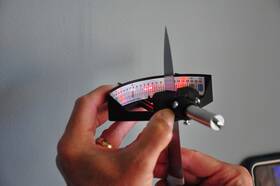
( Brand: Leonards Way ), ( Manufacturer Part Number: 0118-J7447 ), ( Part Type: Laser Knife Reader ), ( Regulatory Compliance Certification: Ul4200a ), ( Grit Type: Fine ), ( Material: Stone ), ( Unit Count: 1.0 ), ( Batteries Included : Yes ), ( UPC: 683332841390 ), ( Package Dimensions Lxwxh: 6.57x5.39x1.38 Inches ), ( Weight: 0.29 Pounds )
Review LEONARDS WAY Lao Laser Knife Edge Reader See How Sharp Your Is Precision. Fo
The **Leonards Lao 0118-J7447 Laser Knife Edge Reader** is a high-precision, cutting-edge optical measurement instrument designed for professionals who demand unparalleled accuracy in dimensional analysis, surface profiling, and edge inspection. Engineered with advanced laser technology, this device employs a **knife-edge sensor** a sophisticated optical system that projects a finely focused laser line onto the surface of a workpiece, allowing for real-time, non-contact measurement with sub-micron resolution. Whether used in manufacturing, quality control, research laboratories, or precision engineering, the J7447 excels in capturing intricate details of edges, contours, and surface irregularities with exceptional clarity, making it indispensable for applications requiring flawless tolerances.
The device features a **compact yet robust design**, integrating a high-performance laser source with a precision optical lens system that ensures minimal beam divergence, reducing measurement errors and enhancing reliability. Its **automated scanning mechanism** allows for seamless, repeatable data acquisition across complex geometries, while the accompanying software interface provides intuitive tools for data analysis, including 3D surface mapping, cross-sectional profiling, and deviation analysis. The laser knife-edge sensor operates on the principle of **interferometric detection**, where the laser beam s reflection off the workpiece s edge is analyzed to determine exact dimensions with remarkable consistency, even on delicate or irregular surfaces.
Built for durability, the J7447 is constructed from high-grade materials, ensuring resistance to environmental factors such as dust, moisture, and temperature fluctuations, which is crucial for industrial and laboratory settings. Its **modular connectivity options** including USB, Ethernet, and RS-232 interfaces enable seamless integration with CAD/CAM systems, CNC machines, and other digital workflows, streamlining data transfer and automation. Additionally, the device supports **customizable measurement parameters**, allowing users to adjust scanning speed, resolution, and sampling density to match specific project requirements, whether for micro-scale precision or large-scale surface analysis.
Ideal for industries such as **semiconductor manufacturing, aerospace, automotive, and medical device production**, the J7447 is particularly well-suited for inspecting high-precision components like blades, molds, lenses, and micro-electromechanical systems (MEMS). Its ability to detect even the slightest deviations down to fractions of a micrometer helps prevent costly defects, ensuring compliance with stringent industry standards. With its **user-friendly calibration routines** and comprehensive documentation, the Leonardo Lao 0118-J7447 Laser Knife Edge Reader empowers engineers and technicians to achieve unmatched precision in their work, bridging the gap between theoretical design and real-world manufacturing excellence.
The **Leonards LAO-0118-J7447 Laser Knife Edge Reader** is a precision tool designed for measuring the sharpness and geometry of blades, particularly in industrial, manufacturing, or DIY settings. Below is a detailed breakdown of its pros and cons, followed by a conclusion and recommendation.
---
### **Pros**
1. **High Precision Measurement**
The device uses a laser-based system to detect the exact angle and sharpness of a blade s edge with minimal human error. This ensures consistent and repeatable results, which is critical for quality control in manufacturing or professional sharpening.
2. **Non-Contact and Non-Destructive**
Unlike traditional methods that rely on physical contact (e.g., feeler gauges or visual inspection), this laser reader provides measurements without altering or damaging the blade. This is particularly useful for testing expensive or delicate tools.
3. **Quick and Efficient**
The laser-based approach allows for rapid measurements, reducing the time required compared to manual methods. This is beneficial in high-volume production environments where speed matters.
4. **Versatile Application**
The tool can measure a wide range of blade types, including knives, scissors, surgical instruments, and industrial cutting tools. Its adjustable settings may accommodate different blade geometries.
5. **Data Logging and Connectivity**
Some models in this series (or compatible software) may offer data logging or connectivity to computers, enabling users to track measurements over time, analyze trends, or integrate results into larger quality control systems.
6. **Durability and Build Quality**
Leonards is a reputable brand known for industrial-grade tools. The LAO-0118-J7447 appears to be built for rugged use, with a sturdy construction that can withstand frequent use in workshop or factory settings.
7. **User-Friendly Interface**
The design likely includes a clear display and intuitive controls, making it accessible for operators with minimal training. This reduces the learning curve compared to more complex metrology tools.
8. **Cost-Effective for Precision Needs**
While not as expensive as high-end CMM (Coordinate Measuring Machine) systems, it offers professional-grade precision at a lower cost. This makes it a practical choice for small to medium-sized businesses or workshops.
---
### **Cons**
1. **Limited to Edge Geometry**
The tool specializes in measuring knife edges and sharpness angles but cannot assess other blade attributes like material hardness, heat treatment, or overall structural integrity. For comprehensive blade analysis, additional tools would be needed.
2. **Calibration Requirements**
Like all precision instruments, the laser reader may require periodic calibration to maintain accuracy. This adds maintenance overhead, including potential downtime or the need for specialized calibration services.
3. **Initial Setup Complexity**
Proper use of the device may require initial setup, such as aligning the laser or adjusting for specific blade types. Users unfamiliar with precision measurement tools might need training to operate it effectively.
4. **Dependence on Clean Surfaces**
Dust, oil, or debris on the blade can interfere with laser readings, leading to inaccurate measurements. This requires additional cleaning steps, which can slow down the process in dirty environments.
5. **Single-Purpose Tool**
The LAO-0118-J7447 is designed exclusively for knife edge measurement. If your workflow requires other types of measurements (e.g., dimensional checks, surface roughness), you would need to invest in additional tools.
6. **Potential Learning Curve for Advanced Features**
While the basic operation is straightforward, advanced features like data logging or custom settings might require familiarity with the software or manual. This could be a barrier for users without technical experience.
7. **Price Point**
While more affordable than high-end alternatives, the cost may still be prohibitive for very small businesses or individual hobbyists. The investment must be justified by the volume of blades being tested.
8. **Limited Portability**
Depending on its size and power requirements, the device may not be as portable as handheld alternatives. This could be a drawback for users who need to test blades on-site or in multiple locations.
---
### **Conclusion**
The **Leonards LAO-0118-J7447 Laser Knife Edge Reader** is a highly specialized and precise tool tailored for applications where accurate blade edge measurement is critical. Its laser-based technology offers speed, consistency, and non-destructive testing, making it ideal for industrial settings, quality control, or professional sharpening services. The device excels in environments where repeatability and data-driven decisions are essential, such as manufacturing plants or workshops producing high volumes of blades.
However, it is not a versatile metrology tool and lacks the breadth of functionality offered by more comprehensive systems. Its effectiveness depends on proper calibration, clean working conditions, and user training. For users who prioritize edge precision and have the budget to invest in a dedicated tool, this reader is a strong choice. Conversely, those requiring broader measurement capabilities or operating in less controlled environments may find it less suitable.
---
### **Recommendation**
**Buy the Leonards LAO-0118-J7447 if:**- You work in an industrial or manufacturing setting where precise blade edge measurement is critical for quality control.
- Your workflow involves testing a high volume of blades regularly, and you need a fast, non-destructive method.
- You are willing to invest in a specialized tool and can justify the cost with long-term benefits like reduced waste or improved product consistency.
- You have access to proper calibration and maintenance resources.
**Avoid or consider alternatives if:**- You need a multi-purpose measurement tool that can assess dimensions beyond blade edges.
- Your budget is limited, and you can achieve similar results with lower-cost manual methods (e.g., protractors or feeler gauges).
- Your environment is highly dirty or dusty, as this could interfere with laser accuracy without additional cleaning steps.
- You are an individual hobbyist or small-scale user who does not require professional-grade precision.
**Alternatives to Consider:**- For hobbyists or casual users, a **digital protractor** or **angle finder** may suffice for basic edge checks.
- For broader dimensional measurements, a **portable CMM** or **coordinate measuring machine** might be more versatile.
- If you need surface roughness or material testing, additional tools like a **surface roughness tester** or **hardness tester** would be necessary.
In summary, the Leonards LAO-0118-J7447 is a well-suited investment for professionals who demand precision in blade edge measurement but may not be the best fit for casual users or those with broader metrology needs.
Details:
This laser device accurately provides measurement of the angles your sharpened knife.
part #: 0118j7447 price
- $24.95
specifications sharpeneroz:
- brand: Leonards Way
- mpn: 0118-j7447
- part type: Laser Knife Reader
- regulatory compliance certification: Ul4200a
- grit type: Fine
- material: Stone
- unit count: 1.0
- batteries included : Yes
- upc: 683332841390
- package dimensions lxwxh: 6.57x5.39x1.38 Inches
- weight: 0.29 Pounds
payments sharpeneroz:
- wallet: Paypal
- credit card: Visa
- other
shipping sharpeneroz:
- transit: 6-9 Days
- carrier: USPS
- type: Fixed
- service: USPS First Class Letter
- cost: $0.00
- class: Standard
offer sharpeneroz:
- quantity: 1
- started: April 21, 2026
- options: Ship-to-home
- sold: 0
- availability: In Stock
returns sharpeneroz:
- time: 30 Days
- policy: Returns Accepted
- method: Money back
- paid by: Seller
general sharpeneroz:
- condition: New
- Kitchen, Dining Bar > Kitchen Tools Gadgets > Sharpeners
seller sharpeneroz:
- rating: 99.4%
- # reviews: 178
- city: Cypress, California
Leonards Way 0118-J7447 Is Similar To:
- Leonards Way 544890 Laser Knife Edge Reader Knowing Your Angles With This Goiniometer (66.3% similar) This listing is for laser knife edge reader knowing your angles with geometer, stop guessing at the angle you are sharpening your knives with Leonards Way an affordable laser geometer easy enough average sharpener to use. Stop guessing at the angle you are sharpening your knives with this affordable...(February 24th, 2025)
- Leonards Way 65498 Laser Knife Edge Reader Knowing Your Angles With Goniometer (66.7% similar) Stop guessing at the angle you are sharpening your knives with Leonards Way an affordable laser geometer easy enough for average sharpener to use. Item brand: Leonards Way. The sharp edge you put on your blade is the key determining factor to knifes performance. Item mpn: 65498. You can now use ...(June 6th, 2025)
- Leonards Way 451215 Laser Knife Edge Reader Knowing Your Angles With Goniometer (67.1% similar) $sagest new date .get time brand new laser knife edge reader knowing your angles with Leonards Way geometer. Item mpn: 451215. Item brand: Leonards Way. Stop guessing at the angle you are sharpening your knives with Leonards Way an affordable laser geometer easy enough for average sharpener to use. ...(June 18th, 2025)
- Leonards Way 54610 Laser Knife Edge Reader Knowing Your Angles With Goniometer (66.7% similar) Item brand: Leonards Way. Item mpn: 54610. This listing is for laser knife edge reader knowing your angles with Leonards Way geometer stop guessing at the angle you are sharpening your knives with Leonards Way an affordable laser geometer easy enough average sharpener to use. The sharp edge you put ...(July 18th, 2025)
- Leonards Way 546516 Laser Knife Edge Reader Knowing Your Angles With Goniometer (67.1% similar) You can now use laser accuracy to get a quick and precise angle measurement, no more guessing. Item brand: Leonards Way. This listing is for laser knife edge reader knowing your angles with Leonards Way geometer stop guessing at the angle you are sharpening your knives with an affordable laser ...(October 28th, 2025)
- Leonards Way 45128 Laser Knife Edge Reader Knowing Your Angles With Goniometer (67.4% similar) Item brand: Leonards Way. You can now use laser accuracy to get a quick and precise angle measurement, no more guessing. Item mpn: 45128. The sharp edge you put on your blade is the key determining factor to knifes performance. Stop guessing at the angle you are sharpening your knives with Leonards ...(November 19th, 2025)
- Leonards Way 59305 Laser Knife Edge Reader Knowing Your Angles With Goniometer (66.7% similar) The sharp edge you put on your blade is the key determining factor to knifes performance. Item brand: Leonards Way. Stop guessing at the angle you are sharpening your knives with Leonards Way an affordable laser geometer easy enough for average sharpener to use. Item mpn: 59305. You can now use ...(March 24th, 2026)
- Leonards Way 2259 Laser Knife Edge Reader Knowing Your Angles With Goniometer (65.9% similar) Item brand: Leonards Way. Stop guessing at the angle you are sharpening your knives with Leonards Way an affordable laser geometer easy enough for average sharpener to use. You can now use laser accuracy to get a quick and precise angle measurement, no more guessing. The sharp edge you put on your ...(April 21st, 2026)